Has anyone ever had this experience
After a hard day’s work, I couldn’t fall asleep when I lay in bed at night. So I started to review what had happened today. After finishing today’s review, I began to plan what to do tomorrow. These thoughts kept swirling in my mind, and I just couldn’t fall asleep.
But one peaceful evening, you are sitting on the sofa, ready to watch TV or browse your phone for a while. Soon, drowsiness strikes you, and then you fall asleep naturally.

Why is it easy to fall asleep on the sofa but hard to do so in bed?
Sleep that is “scared away”
There are many reasons why a sofa can help people fall asleep smoothly: the dim light in the evening, the comfortable temperature, the moderate hypnotic sound coming from the TV or mobile phone, and the soft sofa providing just the right amount of wrapping… … The most crucial point is that a sofa does not give people the anxiety of “having to fall asleep” like a bed does.
Yes, “having to fall asleep” itself is also a source of anxiety. This kind of anxiety may arise when people worry about not getting enough sleep or not falling asleep fast enough.
Lying in bed means the day is officially over. If you are under a lot of work pressure and many tasks are about to reach their deadlines, these things are bound to pop up in your mind, making you toss and turn.
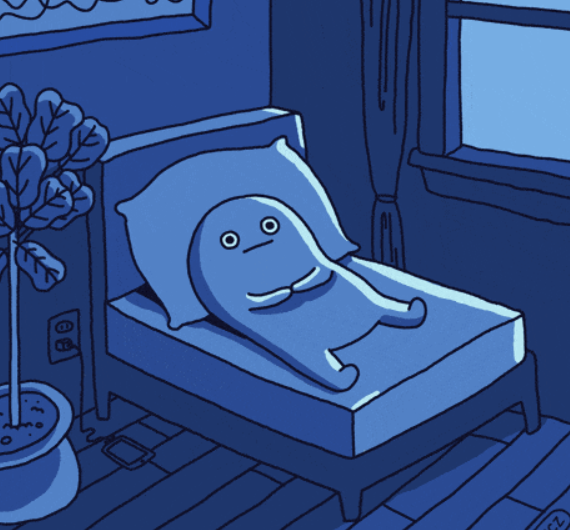
Time passed bit by bit. Half an hour, then an hour, you still couldn’t fall asleep. At this point, you start to worry about the quality of your sleep. You should have had seven hours of sleep, but now you only have six. You are worried that lack of sleep will make you listless and lackluster the next day, and then make you even more anxious.
You force yourself to close your eyes hard and try to empty your mind, but it’s of no avail. The night is spent in such anxiety, and the time you truly fall asleep is pitifully little.
Whether it’s high work pressure, overthinking or having coffee in the afternoon, these factors keep the brain constantly active, making it hard for people to fall asleep. Lack of sleep, in turn, increases stress, creating a vicious cycle that affects daily life and raises the risk of cardiovascular diseases and obesity, thereby harming physical health.
A survey in 2023 found that among people with sleep problems, 36% were unable to fall asleep because they were worried about not being able to sleep. The survey also found that although people can’t fall asleep in bed, they may fall asleep in the office, in the cinema, on the bus, and even at party places.
Improving sleep starts with understanding?
Some viewpoints hold that if people want to improve their sleep, they can learn about their sleep patterns through wearable devices such as fitness trackers and smartwatches.
However, some other studies have found that these smart devices might also be quietly increasing your sleep anxiety. Scholars from the University of Oxford once conducted a study in which insomniacs were divided into two groups. One group was told that their sleep quality at night was “good”, while the other group was told that their sleep quality was “poor” (the fact was not really like this; they were just told such a result).
Those who sleep “poorly” consider themselves more sleepy and in a worse mood than those who sleep “well”. People who sleep well, on the other hand, consider themselves in a better state.
Matthew Reid, a neurologist atthe Johns Hopkins School of Medicine, warns that people who overly focus on sleep scores may be negatively affected as a result, especially those who already have sleep problems. They will also be more interested in sleep monitoring devices.
If you are already anxious about sleep, getting feedback on sleep quality at any time will definitely make you more frustrated.
Relax – it’s easier said than done
Occasional difficulty falling asleep is normal and there’s no need to worry too much. Kim Hutchison, a sleep medicine expert at Oregon Health & Science University, said, “It is very rare for people to immediately transition from a awake and active state to a asleep state.”
For the brain, the switch between these two states is a huge transformation. When you fall asleep, your brain activity gradually slows down. This transformation is partly controlled by environmental factors, such as light and temperature. It’s too hot at night in summer and the street lamps outside the window are too bright, both of which may keep you awake.
You can only fall asleep when both your body and mind feel safe. So when you are anxious and stressed, it is natural for you to have difficulty falling asleep or wake up easily at night.

Yes, if you are under too much pressure, not only will you have trouble falling asleep at night, but even if you manage to fall asleep, you are likely to wake up around three or four in the morning, making the next stage of falling asleep even more difficult. This is because during normal sleep at night, between 3 and 4 o ‘clock, our core body temperature starts to rise, the secretion of melatonin (a sleep hormone) reaches its peak, and the level of cortisol (a stress hormone) gradually increases, preparing the body for the new day.
If you have too many thoughts in your mind, you may encounter some trouble at midnight. “After midnight, the brain’s ability to solve problems declines, but it’s easier to discover new problems,” said Roxanne Prichard, a neuroscientist at the University of St. Thomas in Minnesota, USA. If you wake up in the middle of the night, you are more likely to recall the things you didn’t do well during the day, constantly thinking about the worst outcome but unable to find a solution. So when you wake up at three in the morning, you are more likely to fall into panic and self-blame.
There are many ways to help people fall asleep. You can give them a try: play some light music or white noise, read a book before going to bed, try to meditate, and create the most suitable atmosphere for falling asleep for yourself.
“Shuffle the cards” of the brain
The investigation found that people who sleep well report experiencing “hallucinations” before going to bed, with some unrealistic and illogical things popping up in their minds. People who have poor sleep, on the other hand, say they make plans and try to solve problems before going to bed. Sleep experts say that we don’t need to let our minds go blank (which would be counterproductive), but rather avoid overly logical thinking.
In 2016, Luc Beaudoin from Simon Fraser University in Canada developed a method of “continuous diverse imagination”, known as Cognitive Shuffle, which helps people shift their thoughts away from anxiety and complex thoughts before going to bed.
This method is very simple. In the English context, you can first imagine a word, such as “cat”, and then try to think of all the words you can think of for each letter. For example, close, car… apple, abandon… tea, telephone… Wait a moment. Whenever a word comes to mind, take some time to think about its meaning or appearance.
This process mimics the brain activity specific to the brief transition period between wakefulness and sleep. In an experiment, scientists discovered that this method can effectively reduce sleep problems.
However, this method is not effective for everyone. If your sleep disorder is already very serious and even affects your daily life, it is still necessary to seek medical attention as soon as possible.