The story of Noah’s Ark is widely known, but few people study where this giant boat carrying thousands of living beings finally berthed. When the legend ended, birds returned to the sky, and human beings went to a new wilderness, a new chapter about continuity and hope quietly unfolded. Whether it is the interpretation of legends or the pursuit of history, in the cycle of beginning and end, in the interweaving of joy and suffering, time itself has become the most permanent container to seal everything.
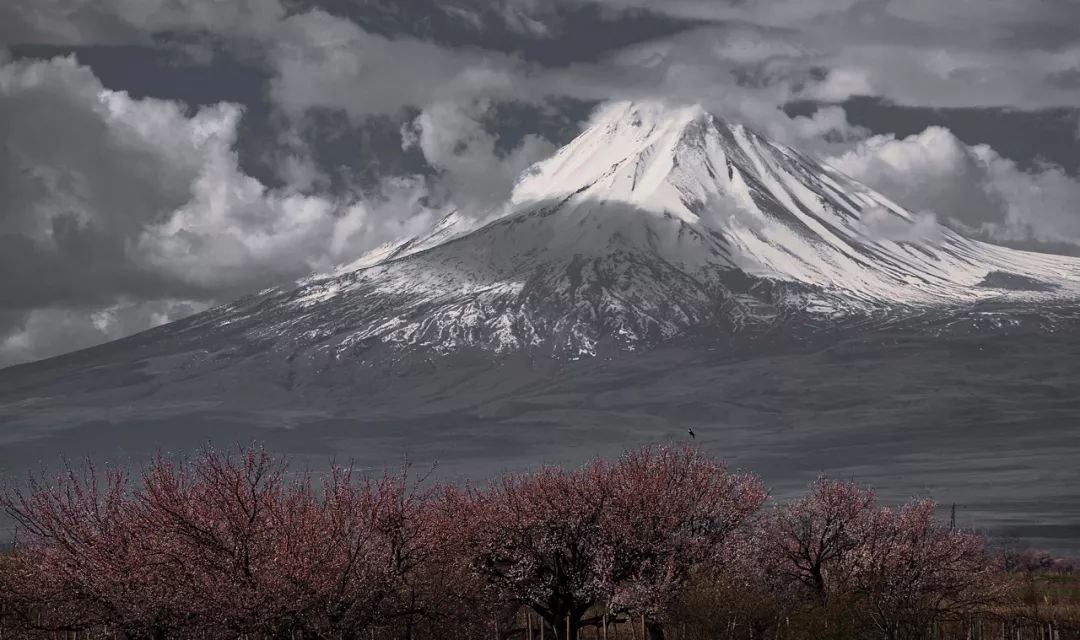
According to legend, the final berthing point of the Ark is in today’s Armenia. Armenian ethnic groups are famous for their business wisdom, but they are not good at force. More than a hundred years ago, the tragic massacre launched by the Ottoman Turkish Empire almost brought this nation to the brink of extinction. Mount Ararat, respected by the Armenians as the “sacred mountain” and not far from the legendary docking of the Ark, is now mostly located within the eastern border of Turkey.
In my memory, whether looking out from the window of the Yerevan Hotel, standing on the vast rooftop of the Yerevan Stairway, strolling through the ruins of the Garni Temple in ancient Greece, or on the way to the monastery in the former deep pit, its figure always inadvertently becomes the most permanent coordinate on the horizon.
After suffering, people still stick to this homeland and guard their holy mountain.
Armenian Flavor Psalms
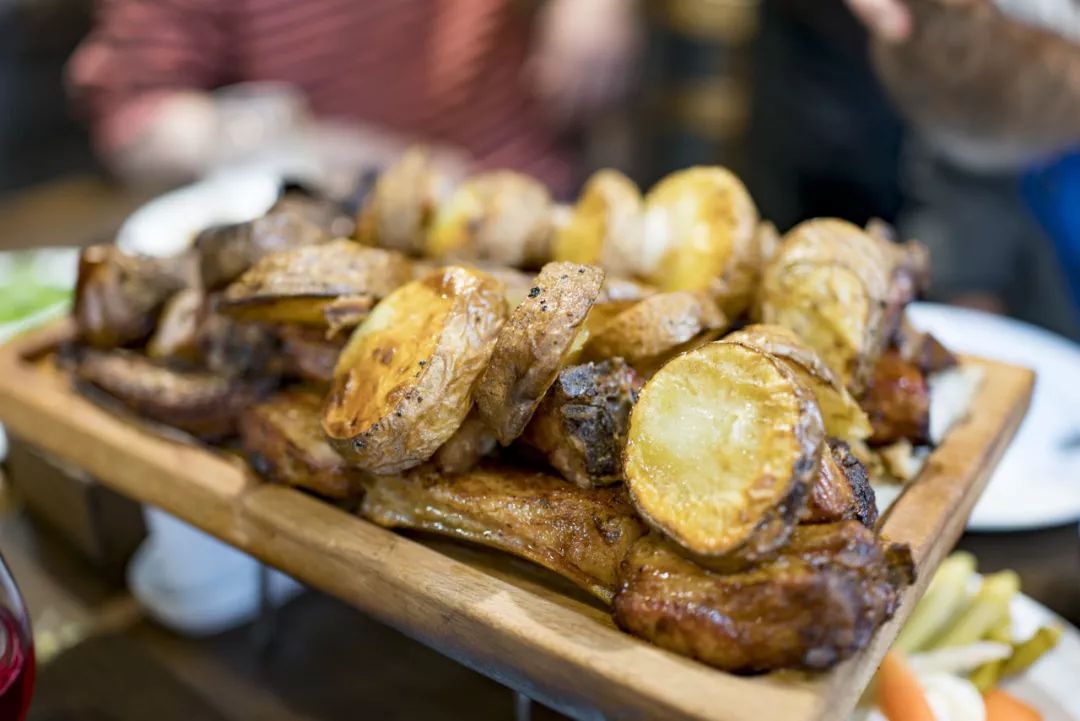
The first formal dinner in Armenia was held at a wine estate outside Yerevan. The manor is located in a valley not far from the city, and the host treats us with several of the most representative local delicacies. The most impressive thing is the braised beef in a clay pot-the beef is marinated in a clay pot and simmered slowly. The flavor is similar to Pingyao beef in China. Although the production is not complicated, it is quite time-consuming to ensure that the beef is delicious and soft. Another dish cooked with minced meat, vegetables and grains wrapped in grape leaves was swept away as soon as it was served. The flavor of stewed mutton here is very similar to that of “hand-caught mutton” in Gansu, Xinjiang and other places. They have the same origin and almost the same production methods. The ancient Silk Road was once an important channel for the spread of food skills.
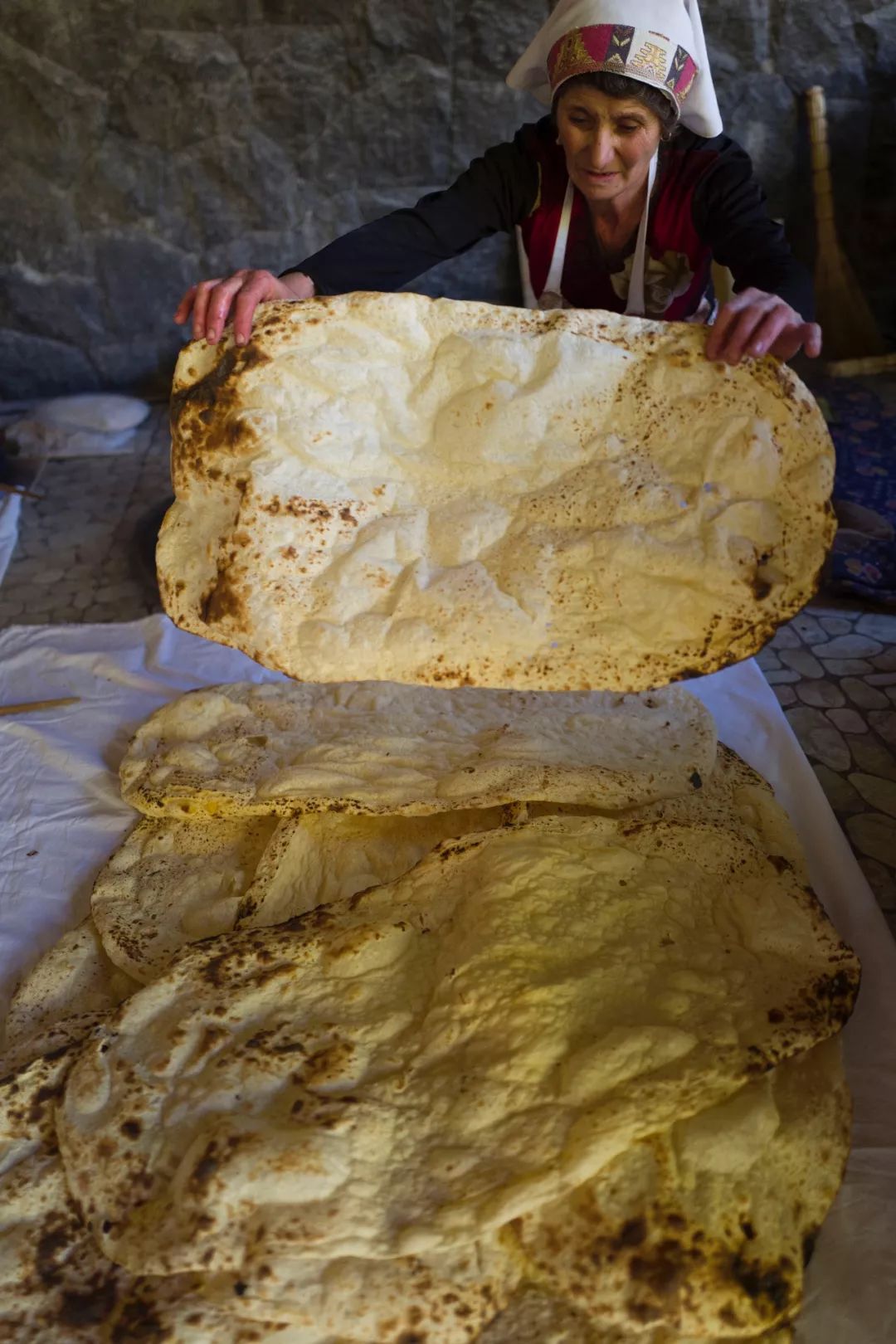
Nothing compares to the aroma emanating from freshly baked “naan”. This is also the food spread along the Silk Road, but its shape varies in different regions. Armenians prefer to use the word “bread” when introducing it grandly. Locals call it “Toneer”, and its production method is quite unique: a pothole about one meter deep is excavated in the ground, a charcoal fire is placed, the dough is spread on a wooden board shaped like a pillow, sticked to the wall of the pit, and baked in half a minute. The food was almost inseparable from me for the rest of the journey.
The first meal is chosen at the winery, naturally for fine wine. Armenians not only firmly believe in the existence of the Garden of Eden, where Noah finally anchored the ark, but also that the first glass of wine in the world was made in Armenia.
They told me that, according to the Bible, this is where Noah planted his first vine after the flood receded. Archaeological discoveries also confirm this point: not long ago, archaeologists discovered the site of a winery about 6,100 years ago on the hillside of Ararat, not far from the city, which contained not only a large stone trough for squeezing grapes, but also clay pots for fermentation.
They describe their love for food this way: “Armenians express their love in the kitchen.” Because of its location at the hub of the Asia-Europe Silk Road, the cuisine here blends different elements and characteristics of the East and the West, making travelers from Asia feel free to feel estranged.
More interestingly, Armenian table customs also combine eastern and western styles, including separate meals and joint meals. Most of the time, dishes are served in big dishes and bowls, and everyone sits around and shares, and the atmosphere is happy.
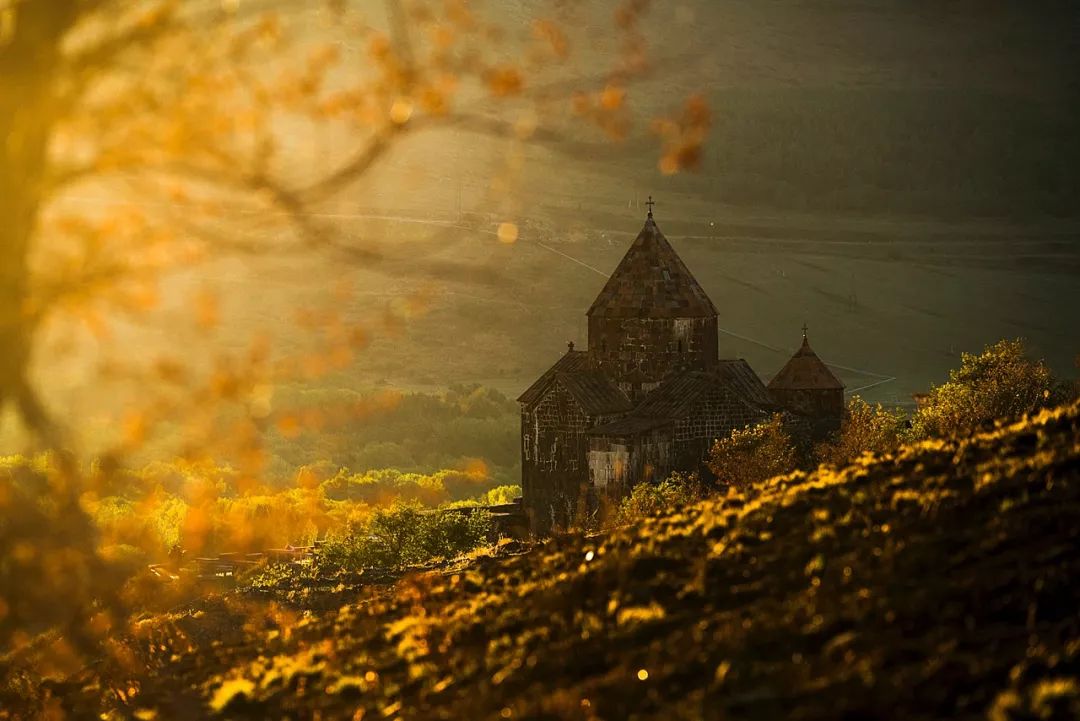
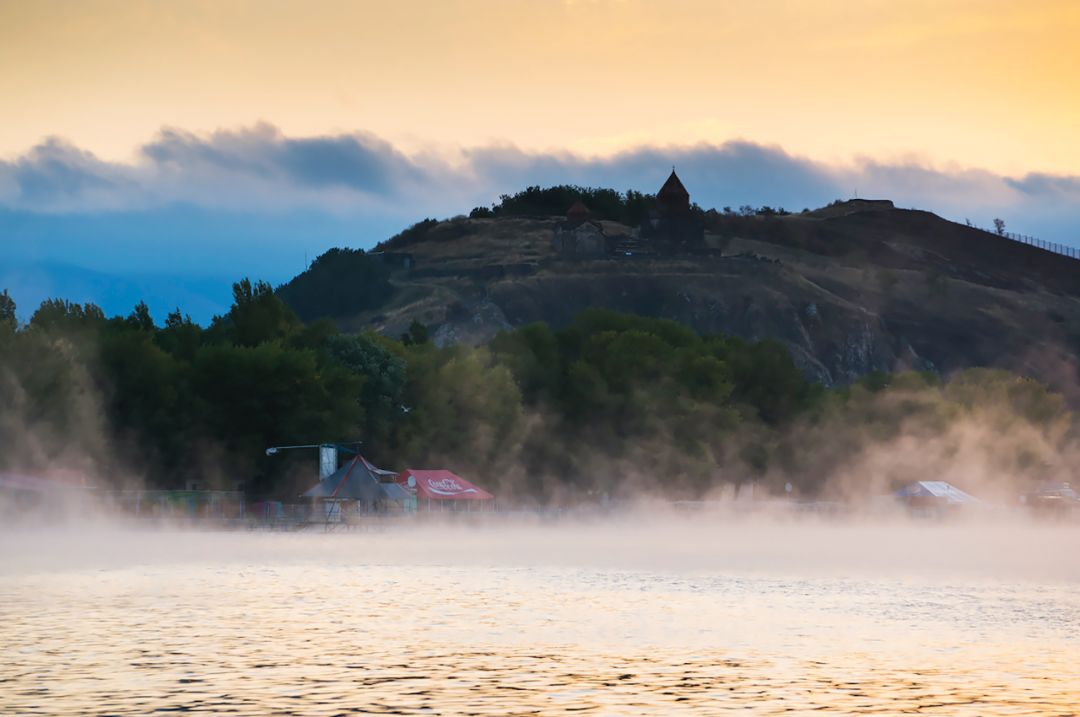
On the other side of Lake Sevan are rolling mountains covered by forests, and Diliran Resort is located in this dense virgin forest. This resort is mentioned in particular because it is a relic of the former Soviet era. I learned from insiders that during the former Soviet Union, workers and soldiers from all over the world loved to come here for recuperation. At that time, those who could enjoy this kind of treatment were usually model workers or leaders who had made outstanding contributions in their respective fields. The facilities of the resort were luxurious at the time, beyond the comparison of ordinary nursing homes.
Another attraction here is the small town of Diliran, a few kilometers away from Diliran Resort. This historic town has now been transformed into a settlement of craftsmen by Armenians who love art. There are many craftsmen here, and most of Armenia’s most famous woodcarving, pottery, embroidery and weaving craftsmen have workshops or studios here. Sochi, a traditional carpenter, is skilled, and a thank-you letter written to him by US President Bill Clinton hangs on the wall of his studio. This is his proudest collection, because during Clinton’s administration, the decoration on the Christmas tree in the White House came from his hand-carved wooden ornaments.
When it comes to handicrafts, we have to talk about the most representative carpet weaving in Armenia. Admittedly, its neighbors Turkey, Azerbaijan and Georgia have similar skills. But what makes Armenians proud is that even though their skills are similar, these countries still regard Armenian handmade carpets as the top grade. This is not only because Armenian carpets have completely inherited the ancient methods made thousands of years ago, but also because they contain the unique artistic perspective and life investment of every weaver.
The Mogelian Carpet Factory is located on the outskirts of Yerevan. The knitting workshop of this factory, founded in 1917, is not large, concentrated in two spacious rooms. The weavers are between 40 and 70 years old and are all female. It is said that only after years of hard practice can real Armenian carpets be woven, and the weavers who can work in this workshop are strictly screened and outstanding.
Half of the factory area is used as an exhibition, which displays all kinds of Armenian handmade carpets collected by the owner. The oldest one is more than 900 years old. Although it is slightly broken, it still looks solid and usable. This is why Armenian carpets have a long reputation in Europe and even Central Asia: a carpet with exquisite patterns is not only a practical thing for one generation, but also can be passed down for several generations. Sometimes, inheriting an old ancestral carpet is more precious than getting a car or a house. Of course, its price is so far high. A handmade carpet of about 2 square meters takes several weavers about half a year to complete, and the price is about $2,000 to $4,000. If it is in Turkey or European countries, its selling price may be several times this.