Do you always toss and turn and find it hard to fall asleep whenever you sleep in a new environment? Even when you lie on a super comfortable bed in a five-star hotel, do you still can’t help but think that the small bed at home is better for sleeping? Such a habit of “recognizing the bed” is indeed a headache for many people. So, why do humans experience insomnia of the nature of “bed recognition”? In the journal Current Biology, Masako Tamaki from Brown University in the United States and her colleagues discovered the essence of the “bed recognition” phenomenon.
Picture 1

What happens in our brain when we can’t sleep well in bed?
Bed Recognition: Picky or Vigilant?
When we often talk about “recognizing a bed”, what we actually recognize is the familiar environment. When people have to spend a night in an unfamiliar environment, they often don’t sleep well – this type of sleep disorder is called the “First-Night Effect” (FNE for short) by sleep experts. This effect is very strong and stable. We often observe it in participants when conducting sleep experiments. In daily life, many people also suffer greatly from it. Even our research team itself has difficulty falling asleep when traveling on business. Yoshiko Tamaki told scientists that they have always been curious about what exactly happens in our brains when we experience this effect.
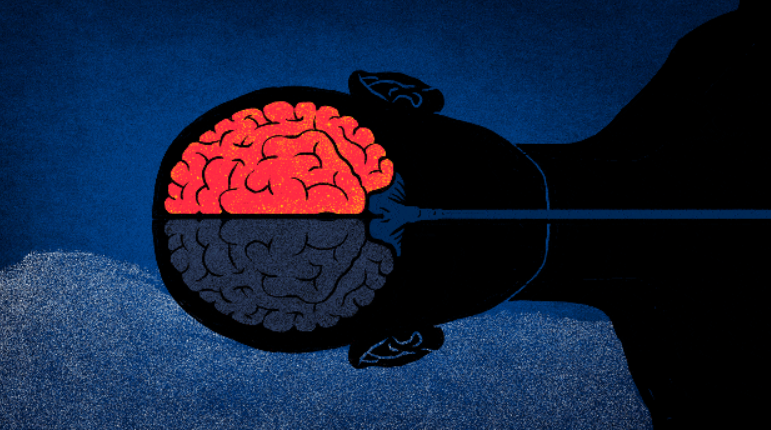
Yoshiko Tamaki and her colleagues learned from earlier studies that in some birds and Marine mammals, there is an interesting phenomenon of “unilateral hemispheric sleep”. When they are sleeping, one side of the brain hemisphere is in sleep mode, while at the same time the other side is awake. Yuzhi Yingzi said. This seemingly strange way of sleeping is very likely to be for better survival. In the nature surrounded by enemies and full of dangers, the awake side of the brain can help them guard against predators. We thus began to wonder if humans also have an asymmetrical rest pattern on both sides of the brain? Since we cannot confirm whether the new environment is safe or not, we should also have an internal monitoring system. She said.
Picture 2

The house sparrow is a kind of bird that has “unilateral cerebral hemisphere sleep”.
I can’t sleep well in a different place
It’s just that one side of the brain is “awake”
To verify this conjecture, they combined techniques such as magnetoencephalography (MEG), magnetic resonance imaging (MRI), and polysomnography (PSG) to conduct neuroimaging of the sleeping brain, detecting their slow-wave activity (SWA) during sleep – the only feature that can reflect the depth of sleep. It was found that on the first day of the sleep experiment, the left and right hemispheres of the brain of the subjects showed different sleep depths during sleep.
After comparing the neural networks of different cerebral hemispheres, Yoko Tamaki discovered that the differences in activity between the left and right cerebral hemispheres on the first night occurred in the so-called “Default mode Network”. The default network is a network system that connects multiple brain regions and is active when people are absent-minded, daydreaming, or distracted. It enables you to briefly break away from the working state and allow your brain to rest when you are awake.
Researchers found that when the subjects spent their first night in an unfamiliar experimental environment, the slow-wave activity of the default network in the left cerebral hemisphere was lower than that in the right cerebral hemisphere, suggesting that these areas had a shallower sleep depth during the first night than the right hemisphere. This state where one side of the brain is “asleep” while the other is relatively “awake” might be the reason why people don’t sleep soundly on their first night.
The slow-wave activity (SWA) intensity of the default network area. Red represents the default network on the left, and blue represents the default network on the right. It can be seen that on the first night (Day 1), the slow-wave activity intensity of the default network on the left is significantly lower, which means a shallower sleep depth. By the second night (Day 2), the slow-wave activity of the default network on the left was restored.
The “Night Watchman” in an unfamiliar environment
During sleep, most of the neural networks in the human brain are at rest, but the default network does not completely shut down, which means it may be very suitable for the role of a “night watchman”. Subsequent research found that on the first night of the sleep experiment, when some “unusual sounds” were briefly played, the responses of the left and right cerebral hemispheres of the subjects to these sounds were also completely different: the amplitude response of the relatively “awake” left cerebral hemisphere was more intense, which meant that its alertness was higher. By the next night, the subjects had become familiar with the environment of the sleep test, and the difference in the default network between the left and right hemispheres of the brain had also disappeared. They slept more deeply than before. (So it’s called the “First Night Effect”…)”
The response amplitudes of the left cerebral hemisphere (red) and the right cerebral hemisphere (blue) to abnormal sounds during the subjects’ sleep on the first night (Day 1) and the second night (Day 2).
The researchers pointed out in the paper that restless sleep in an unfamiliar environment might be a survival mechanism of humans – one hemisphere of the brain remains relatively alert during sleep, thus acting as a “night watchman” to prevent potential dangers. Once an unfamiliar movement is detected, the side of the brain that keeps watch at night will wake up the sleeping person.
Careful people may notice: Why is it the left brain that is responsible for vigilance? Scientists are not sure either. One possible reason is that the functional connections between different regions of the left brain are closer, and this close connection may be more suitable for keeping vigil. Yuzhi Yingzi said, “The second possibility is – not necessarily just the left brain.” Since we only examined the condition of the first sleep cycle (approximately the first 90 minutes of sleep), it is possible that the left brain is responsible for alerting during this stage, but it will be different later on. It’s possible that in the next cycle, even the right brain might take over the night watch, allowing the left brain to rest.
Knowing “why”
Let’s talk about “What to do”
For those who are severely “stuck in bed”, these might not be the key points – even if we change our sleeping location, we no longer need to worry much about wild beasts attacking in our sleep. So, how can we avoid the insomnia caused by “stuck in bed”? In this regard, Yoshiko Tamaki believes: “If we can cut off the default network’s working state before going to bed, it might help us sleep better in the new environment.” We might be able to attempt some non-invasive treatments on the default network on the left side, such as Transcranial Magnetic Stimulation, to weaken the activation state of this area, reduce its alert intensity, and thereby alleviate the bed recognition effect.
Schematic diagram of transcranial magnetic stimulation. The principle of transcranial magnetic stimulation is to use a small magnetic field to interfere with the electrical signals in specific brain regions, enhancing or weakening certain neural activities, thereby achieving therapeutic effects.
Well, what else? Researchers say that some behavioral training methods might also work. Bringing your own pillow, choosing a hotel with a sleeping environment similar to that at home, and even frequently changing places to sleep may all help reduce the problem of “bed recognition”.
In the past, when our ancestors were wandering in the unknown darkness, a high level of vigilance during sleep might have been able to better preserve their lives. Now it seems that “recognizing the bed” is more like a happy worry: it remains a steadfast night watchman, providing you with safe protection in an unfamiliar environment, while also bringing you the restlessness of tossing and turning. It is believed that in the near future, scientists will have a more thorough understanding of this phenomenon and help us rest easy when we are away from home.