When you don’t know what to do, just go to the park. In the spring and summer of Berlin, people can always be easily pushed into a sea of greenery. When I first started learning German, the first example the teacher gave when expressing interests and hobbies was spazieren gehen, which means “taking a walk”. At that time, I was still thinking, how could taking a walk be considered a hobby? It was only after living here for two years that I gradually came to understand that taking a walk is not just a hobby – it is almost a core part of the lifestyle in Berlin or Germany.
For a walk, one needs green Spaces and paths, preferably a continuous park. In spring, one can see the buds and flower buds; in summer, one can listen to the sound of the spring and the flowing water; in late autumn, one can step on the rustling fallen leaves; and in winter, one can leave a string of footprints when heavy snow is falling. There are over a hundred parks of various sizes in Berlin, which perfectly fulfill the wishes of strolling enthusiasts: some are deep and quiet, and one should stroll alone, enjoying a complete afternoon on a bench. Some lawns are spacious and suitable for getting together with friends for a picnic. Choose a weekend to stroll around the flea market.
Of course, this is Berlin after all – beneath the wild wildflowers and grass that grow freely, layer upon layer of historical memories build up another face of the parks: from Tilgarten Park in the west to Trepto Park in the east, from the Berlin Wall Park in the north to the Railway Three-way Pass Park in the south, each park is not only a lush green resting place, but also like a growing city monument: From the manors and woodlands of the imperial era to the traces left by war and division, and then to the public Spaces redefined after the reunification of the two Germanys today, they bear witness to the daily lives of Berliners and silently reflect the city’s century-long changes.
I. Tilgato Park
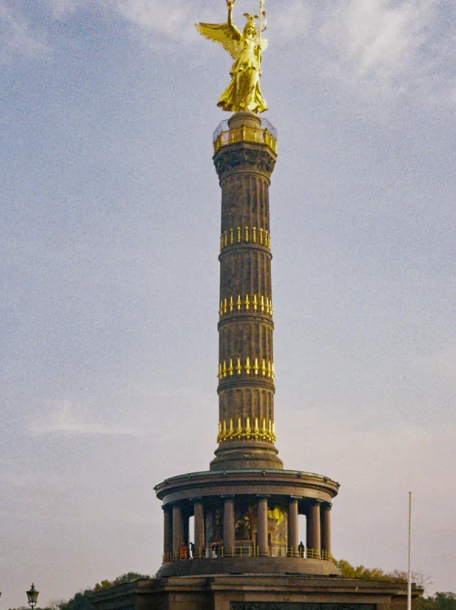
Open the map and search for Berlin, and you will find a large green space in the very center of the city. To the east is the Brandenburg Gate, to the southeast is Potsdamer Platz, to the west is connected to the Berlin Zoo, and the Spree River flows through the north. In the center of the park, there is the Großer Stern Square and the golden Victory column right in the center.
The greenery here is not the neatly tamed flowers and plants found in conventional urban greening. Linden trees, chestnuts, Norwegian maples and plane trees are lush and green, shading the sky, while beneath their branches lies a world of ferns and herbaceous plants spreading. There are no neat roads paved with pebbles or cement, only rough dirt and forest paths trodden by footprints. Wild ducks swim leisurely on the lake surface, and sometimes squirrels can be seen leaping nimbly among the branches. Of course, if it is in the spring when everything comes back to life, one should also be cautious of caterpillars that suddenly float down from the sky.
The green Spaces in Berlin always exude such a “wildness”. Walking through it, one can often see people laying out picnic MATS on the slopes and reading or taking a short rest in the shade of the trees. The bicycle was lying crookedly on one side, with only the chirping of birds audible.
During the Kingdom of Prussia, this freely growing natural place was once a hunting ground for the royal and noble families, and later it was converted into a park for public use. The power and prosperity of the empire are condensed into statues standing in the forest, for people today to pause and ponder.
Youdaoplaceholder0 nearby attractions:
Choose a sunny day to climb to the top of the Victory Column, which offers an excellent view of the Berlin skyline. The memorial column originally symbolized the unified German Empire. During the Nazi period, it was moved from King’s Square (formerly Republic Square) to Tilgarten Park. The 1987 film “Under the Berlin Sky” was also shot here. Looking down at the still divided city from the top of the columns, the scene has a special meaning.
The west side of the park leads directly to the core area of West Berlin: You can view the contemporary photography art exhibition at C/O Berlin, or think about the relationship between architectural restoration and historical memory in the William Memorial Church, which retains the traces of bombs. Enjoy a refined lunch near Savignyplatz and head west along Kondersplatz to discover the most concentrated Asian cuisine in all of Berlin.
- Trepto Park
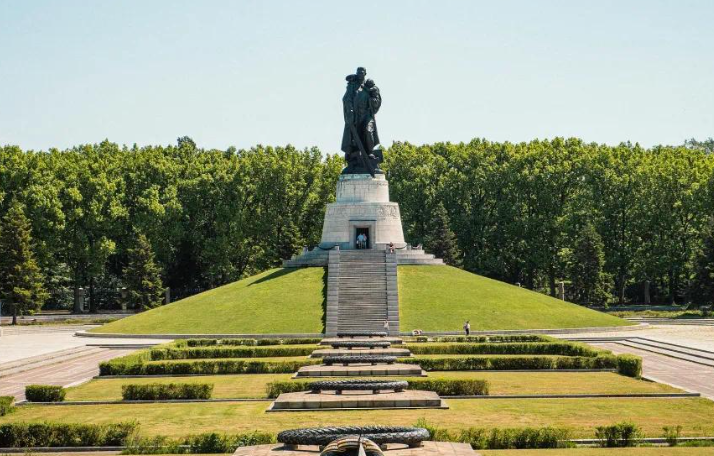
In contrast to the Tiergaten Park in the former West Berlin, there is also such a large green space in the former East Berlin – Treptor Park. It stretches along the Spree River, and between the lush trees and the calm lake water, there ripples the little-known urban memories of Berlin.
If Tilgatton Park is a symbol of the empire’s power and a testament to the prosperity of the citizens’ lives, then Treputo Park reveals another side of what is called “civilization” and “progress”. In 1896, the Berlin Industrial Exhibition was held here, featuring not only machinery and technology, but also the first German colonial exhibition (Die Erste Deutsche Kolonialausstellung) : The colonial people and items that had been otherized were displayed on the green stage of the empire, becoming the “exhibits” that the citizens passing by gazed at with curiosity.
For a long time, Germany’s colonial memory was almost absent from public life. It was not until the last two decades that it increasingly became the focus of social attention. Not confined to academic forums and journals, this discussion also appeared in a more life-like form on the streets, in parks and at exhibitions, constantly reminding people that the shadow of the empire has not faded with time, but lurks on the land beneath their feet that they walk on daily.
And Berlin, as the former capital of the German Empire, has become the core of this discussion. At the Trepto Museum, an exhibition named “looking back” (zuruckGESCHAUT) recreates this controversial memory from a de-colonial perspective. Based on this, the artists have brought these forgotten stories back to their original sites in an extremely innovative way through a sound walk called “telling back” (zuruckERZAHLT).
So, my earliest memory of Trepto Park originated from such a thoughtful and empathetic stroll. A hundred years ago, stories about colonization, race and resistance were told gently through the headphones. Before my eyes, greenery was lush and the sunlight climbed up the white branches. The narration in the ears and the steps underfoot interweave, transforming the park from merely a space for entertainment into a stage that bears the weight of history. At that moment, Trepto Park seemed to be responding in a low voice: Memories have never faded away; they are just waiting to be heard again.
Beyond the colonial memory, in the center of Trepto Park stands a grand Soviet Army monument in memory of the Soviet Red Army soldiers who died in the Battle of Berlin in 1945. After the reunification of Germany, there has always been intense debate over whether this monument should be repaired, preserved or demolished. On the one hand, the violent incidents against civilians (especially women) when the Soviet army entered the city have become an unhealable scar in the hearts of Berlin citizens. On the other hand, the political oppression of the East German government and the Stasi made all the Cold War legacies related to the Soviet Union seem so out of place today.
These entanglements constantly remind people that the rift between the East and the West of Berlin has never truly been smoothed out. Against such a backdrop, the story of another park appears particularly different.
- Berlin Wall Park
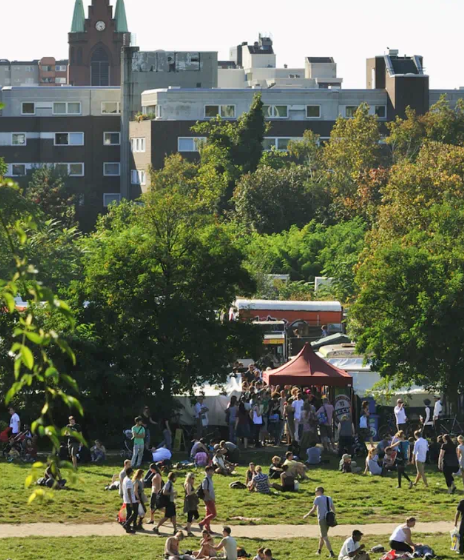
The Berlin Wall Park, as the name suggests, is located right on the dividing line of the former Berlin Wall. A few hundred meters away, the Berlin Wall Ruins Memorial Park still prominently warns of the seriousness and cruelty of history, but on this green land, youth and freedom are blooming freely. Located between Prelenslauberg and Gesundbrunnen, the Berlin Wall Park has witnessed the disappearance of the “wall” and the reconstruction of the urban texture: the blooming cherry blossoms in spring, the ceaseless graffiti creations on the slopes, the lazily scattered crowds on the lawns, and the free, noisy and impromptu energy have become the most distinctive labels of this green space.
Of course, the most popular place here is still the flea market. Every Sunday, the place is crowded with people, turning it into a lively gathering: second-hand vinyl records, old clothes, handicrafts and vintage cameras are displayed on the long table in a dazzling array, waiting for the next owner to continue writing their stories. If you want to take some souvenirs from Berlin, this place is much more interesting than the highly homogeneous gift shops on Friedrich Street.
Just last Sunday, while wandering around, I came across the works of a local Berlin-based photographer, Gerd Danigel. Born in the late 1950s, he has recorded the changes in East Berlin and the reunion of the two societies after the fall of the Berlin Wall throughout his life. One of the works happened to be taken in the Berlin Wall Park in 1990. On the overgrown and desolate stone wall, the crooked font quoted a sentence by Wolfgang Mocker:
Das Leben geht weiter – als wir gedacht haben! Life goes on – not as we imagined!
This mottled graffiti is not only a summary of the earth-shaking changes after the fall of the Berlin Wall, but also seems like a prophecy about the future. More than three decades have passed, and this park has indeed grown in a way that no one could have expected: it is no longer a symbol of estrangement, but an experimental field for the city’s freedom and creativity.
Youdaoplaceholder0 nearby attractions:
Head west along the main road in front of the park to the Berlin Wall Ruins Memorial Park and the Berlin Wall Memorial Hall to learn more historical facts and touching stories, and watch the greenery reappear among the exposed concrete and steel bars.
Starting from the park and heading south, you will arrive at the Arkonaplatz and Zionskirchplatz, which are full of atmosphere. This place is filled with coffee shops, boutiques and creative studios. Not far away, Volkspark am Weinberg is also a beautiful green area. On a sunny day, you can sunbathe on the lawn and then go to the photo pavilion beside it to take a retro four-frame photo of life. If you continue south, you will arrive at Torstaße – welcome to the most chic district in Berlin.
- Railway Three-way Pass Park
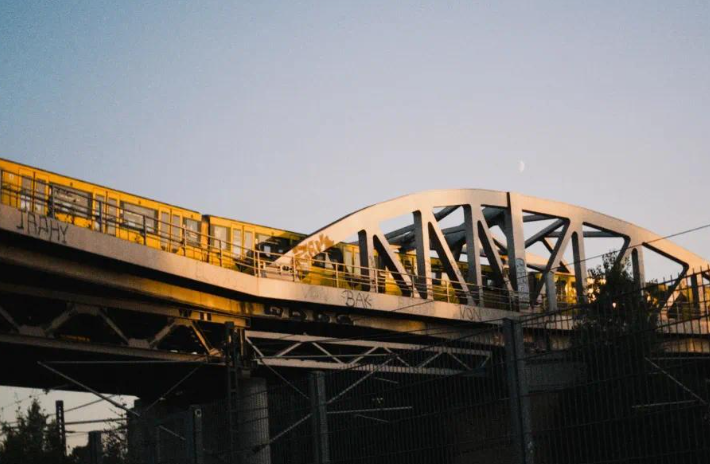
The graffiti creation on the slopes of the Berlin Wall Park has never ceased. Year after year, new color blocks and brushstrokes cover the old works, depicting the changes of this city. However, graffiti does not merely remain on the still walls; it also flows through the traffic veins of Berlin – the metro roars by, its bright yellow bodies illuminated by unauthorized graffiti, becoming a pleasant surprise in daily commutes. If you want to experience the interweaving of such street art and the rhythm of the city, the best place to go is undoubtedly the Railway Three-way Pass Park.
As one of the most contemporary public green Spaces in Berlin, the Railway Three-way Pass Park is built on the ruins of an old railway. Nowadays, the railway tracks on the ground have been abandoned for half a century, but the above-ground subway lines are still busy, with Lines 1, 2 and 3 shuttling here every day. Every time I take Line 3 from the west, I look forward to arriving at this station: the train emerges from underground here, and the view suddenly opens up before my eyes. Sunlight pours in, and the expansive scenery replaces the dim tunnel, making my mood relaxed and free. For me, the charm of Berlin often shines precisely in such “flow”, more vivid than any static gaze.
But when I was in the park and looked up to see the subway passing by, this feeling was reversed: As the train passed by, various flamboyant and brightly colored graffiti on its body also came into my view. The four letters were often the names of the authors, while the three letters were usually the abbreviations of a creative group. There were even dedicated photographers stationed at these fixed positions, capturing these flowing and fleeting artworks every day.
This park is certainly not limited to this. Since its renovation was completed in the 2010s, numerous functional areas have made it one of the most desirable green Spaces for Berliners: the central lawn is always “filled” with people on sunny days in spring and summer, either having picnics and chatting or simply lying down to relax. There are many sports facilities around and quite a few designs for children to play with. A long bike path connects the three districts of Mitt, Schonenberg and Kreuzberg, with commuters hurrying through it on their bikes… These diverse scenes together weave the most “contemporary” urban landscape of Berlin.
Youdaoplaceholder0 nearby attractions:
The north side of the park is adjacent to the German Museum of Science and Technology, and to the southwest lies the lush Victoria Park. In the center of the park stands a Prussian monument, from which one can overlook Großbeeren Street in the distance, and the Victory Waterfall beneath the feet surges all year round. Further east, you will arrive at Bergmannkiez, a place brimming with the vitality of life: creative restaurants and coffee shops are everywhere, and the Marheineke market is home to a wide variety of cuisines from all over the world. When it comes to authentic flavors, the iconic Curry36 flagship store in Berlin is also nearby – when you come here, how could you miss a steaming hot currysausage?
During my days in Berlin, the park held many of my memories, beautiful, ordinary, depressing and confusing. But it seemed that as long as I took a walk in the greenery on a sunny day, all my moods would be soothed and settled smoothly. It is also in the park that life in a foreign land, like trees, has a place to take root and settle down. In the daily cycle, it becomes increasingly concrete and vivid.
The charm of Berlin is not merely about landmark buildings like the TV Tower, Brandenburg Gate and Museum Island, nor is it confined to fleeting street snapshots and alternative life scenes. The green Spaces of this city await people’s exploration – taking a walk in nature, the past and present of Berlin thus emerge.